Afterlife
The Immediate Record
After Louis Brüls died in Rome on 19 December 1882, his life passed into memorial, documentation, and uncertainty. He was buried at the Cimitero del Verano, in the Cappella del Prezioso Sangue. His widow, Anna Maria Micocci, survived him and played a central part in his commemoration. The tomb inscription recorded his death and her devotion, and the monument carried marble portraits of husband and wife. It also introduced one of the biographical errors that would follow him for decades.
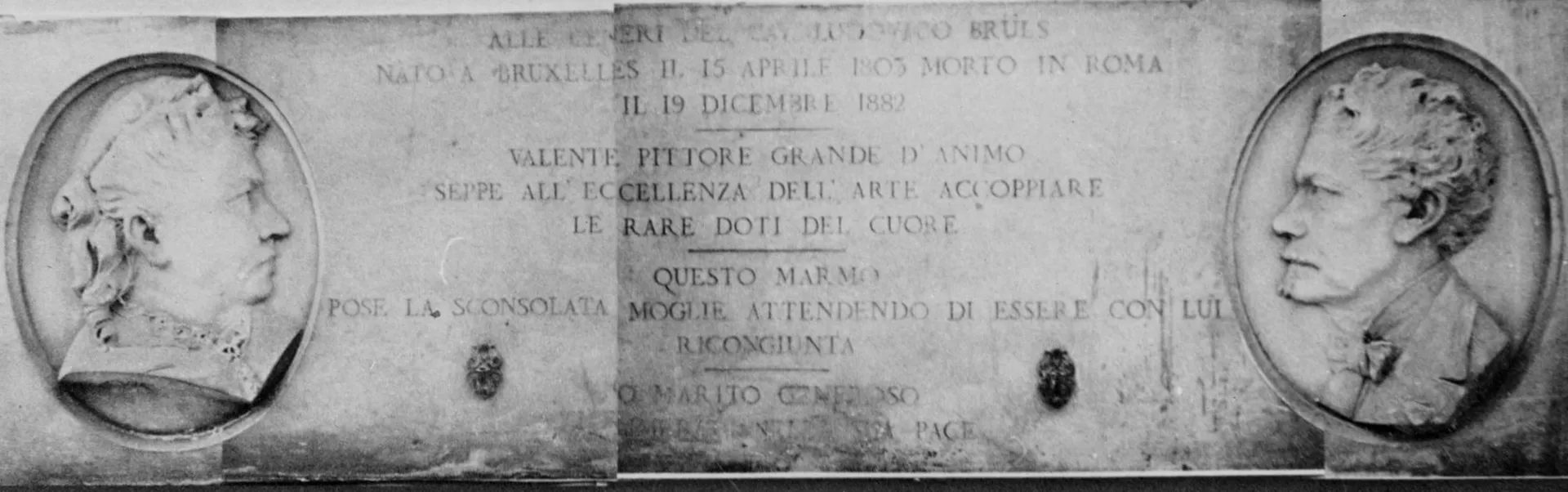
The Hucklenbroich dossier later noted that the monument gave Brussels as his birthplace, while the family tradition represented by the historian and genealogist Jacques Dufrasne insisted on Drinhausen near Übach. From the start, Brüls's posthumous history was shaped by remembrance and by records that disagreed with one another. What happened immediately to his estate and household can only be partly recovered from the material now assembled. No complete account of his estate has yet been found.
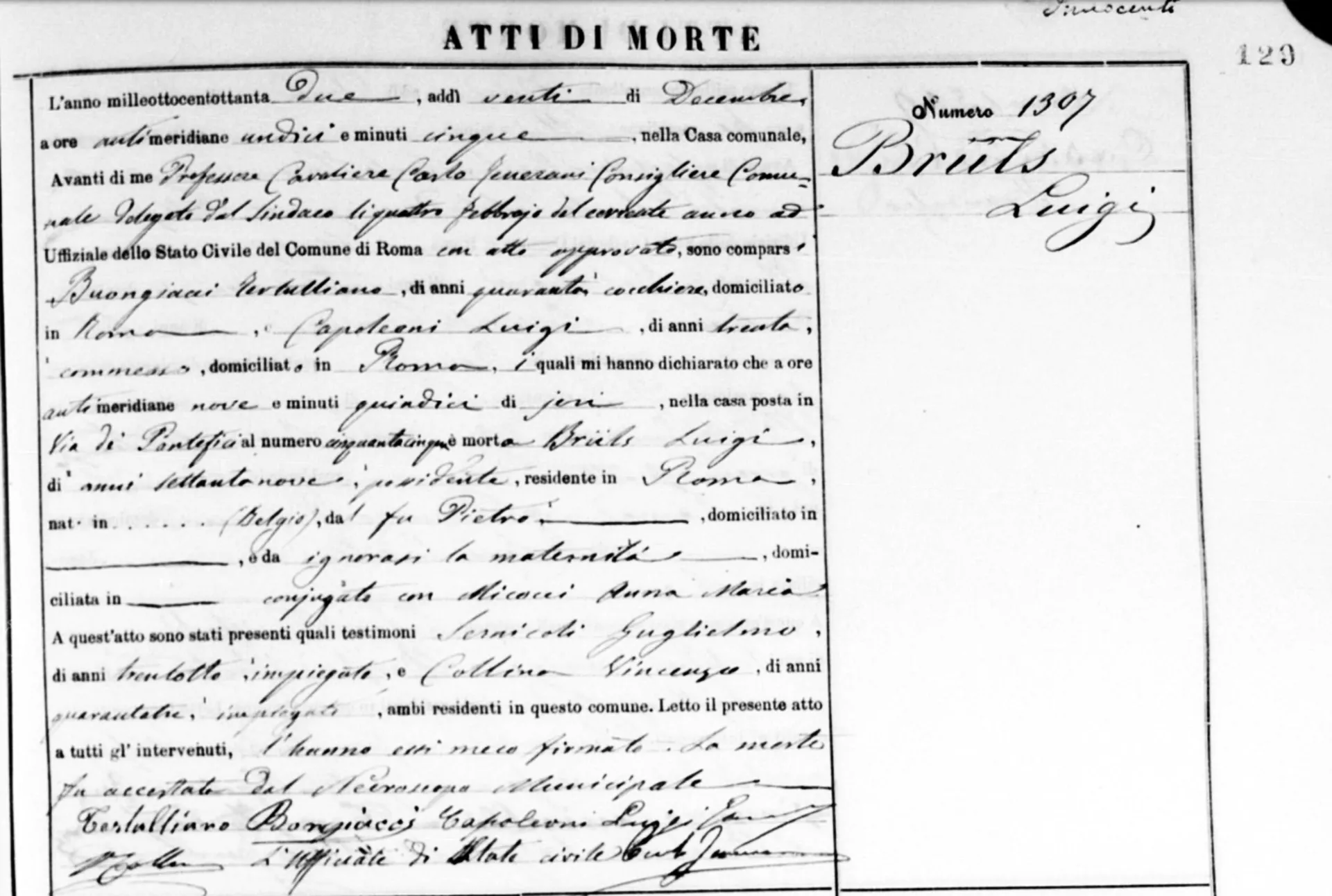
His widow remains visible in the record, as does the tomb. Later family sources also preserved two less certain traditions: that Maria Micocci had served as the model for some of his paintings, and that the couple may have had a daughter. In 1962, Dufrasne described Brüls as having married an Italian woman who was his painting subject, while Dufrasne's genealogy diagrams showed one daughter descending from the union. Marie-Louise Hucklenbroich agreed with this narrative. Léon's dossier was more cautious, noting only that "le peintre Louis Brüls aurait eu une fille."
From the first posthumous generation onward, family memory held together two strands: the widow who certainly existed, and a daughter who remained more a trace in family memory than a fully documented person.
The 1889 catalogue of the Neue Pinakothek in Munich still listed Christ Blessing as the entry for Der Segensspruch, but stated in error that the artist "lives in Rome," an uncorrected error from an earlier edition, seven years after his death.

Notices in the Aachen newspaper Echo der Gegenwart document the death of Franz Theodor Brüls, brother of the painter Louis Brüls, at Drinhausen in 1891, and the liquidation of the Gut Drinhausen estate by his heirs in 1892. He had died unmarried and childless, aged 84, and the estate passed to a body of collateral heirs who instructed the royal notary v. Holtum of Geilenkirchen to wind it up.
Over two sales in March and November 1892, Gut Drinhausen was stripped of its breeding stock, its Belgian draught horses and farm machinery, and finally the entire household, down to the oak cupboards and the linen. The oak trees lining the estate had been cut down by the acquirer, and sold for a substantial profit. This marked the end of the dynasty of Peter Josef Brüls and his descendants in Übach. Several had moved to Maastricht and Liège.

In 1893, J. S. Renier's Inventaire des objets d'art surveyed the churches of Liège and recorded his copy of Fra Bartolomeo's Descent from the Cross at Saint-Denis, noting that Brüls was "d'Ubich, mort en 1883 à Rome," giving the death year incorrectly as 1883, and calling the town Ubich, instead of Übach.
In 1895, the Notizie degli Scavi di Antichità published a discussion of a bronze disc from Cerveteri that had belonged to the Brüls collection in Rome, noting that his collection had been dispersed by then.
The Descriptive Catalogue of the Powers' Art Gallery was published in 1897, in Rochester, New York. The catalogue confirmed the continued presence of two Brüls paintings in the Powers collection as late as 1897, the year of Daniel W. Powers's death.
Louis Brüls appears in the catalogue under the Italianised and misspelled name "LUDOVICO BRUNTS". The misspelling of "Brüls" as "Brunts" was carried over from the earlier 1877 Merriman catalogue and perpetuated in the index and catalogue entries. His nationality is recorded incorrectly throughout as "(Ital.)" Italian.

In 1905, Salomon Reinach's (1858–1932) Esquisse d'une histoire de la Collection Campana drew on Belgian government archives to identify Brüls as "le principal auteur de l'acquisition" of the seventy-seven Greek and Etruscan vases that had entered the Royal Museum in Brussels in 1862–63, restoring credit that had been misdirected to the archaeologist Heinrich Brunn (1822–1894) through a confusion of similar names.
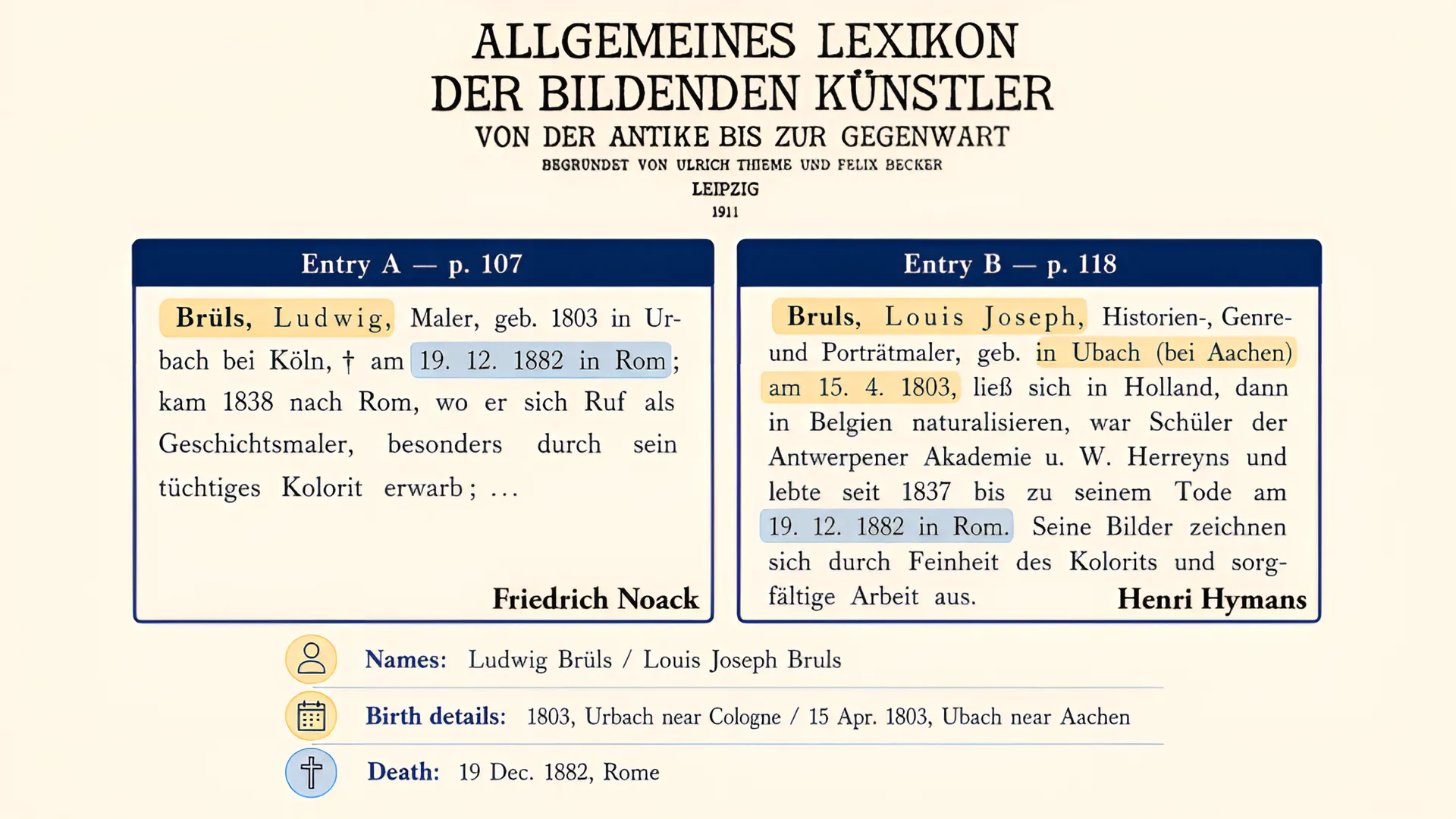
In 1911, the Thieme-Becker Allgemeines Lexikon der bildenden Künstler carried two separate entries for the same man, "Brüls, Ludwig" by Friedrich Noack (p. 107) and "Bruls, Louis Joseph" by Henri Hymans (H.H.) (p. 118), written from different national traditions, with no cross-reference between them. This split would persist uncorrected for nearly a century.
Destruction and Recovery
During the Allied bombing of Munich in 1944, the Neue Pinakothek was completely destroyed. With it perished Brüls's most celebrated work, Der Segensspruch or Le Sauveur bénissant, which had entered the royal Bavarian collection and hung alongside paintings by Overbeck, Schadow, and Schraudolph.
In 1947, a painting titled Taking the Vows, signed and dated "L. Bruls 1872," appeared as lot 56 at Kende Galleries in New York, catalogued under the attribution "Ludwig Bruls, German: 1803–1882." The entry shows how nationality confusion followed his works into the American market. The painting depicted a bishop blessing a kneeling woman taking religious vows, a subject Brüls had first undertaken around 1839 and returned to over three decades later.
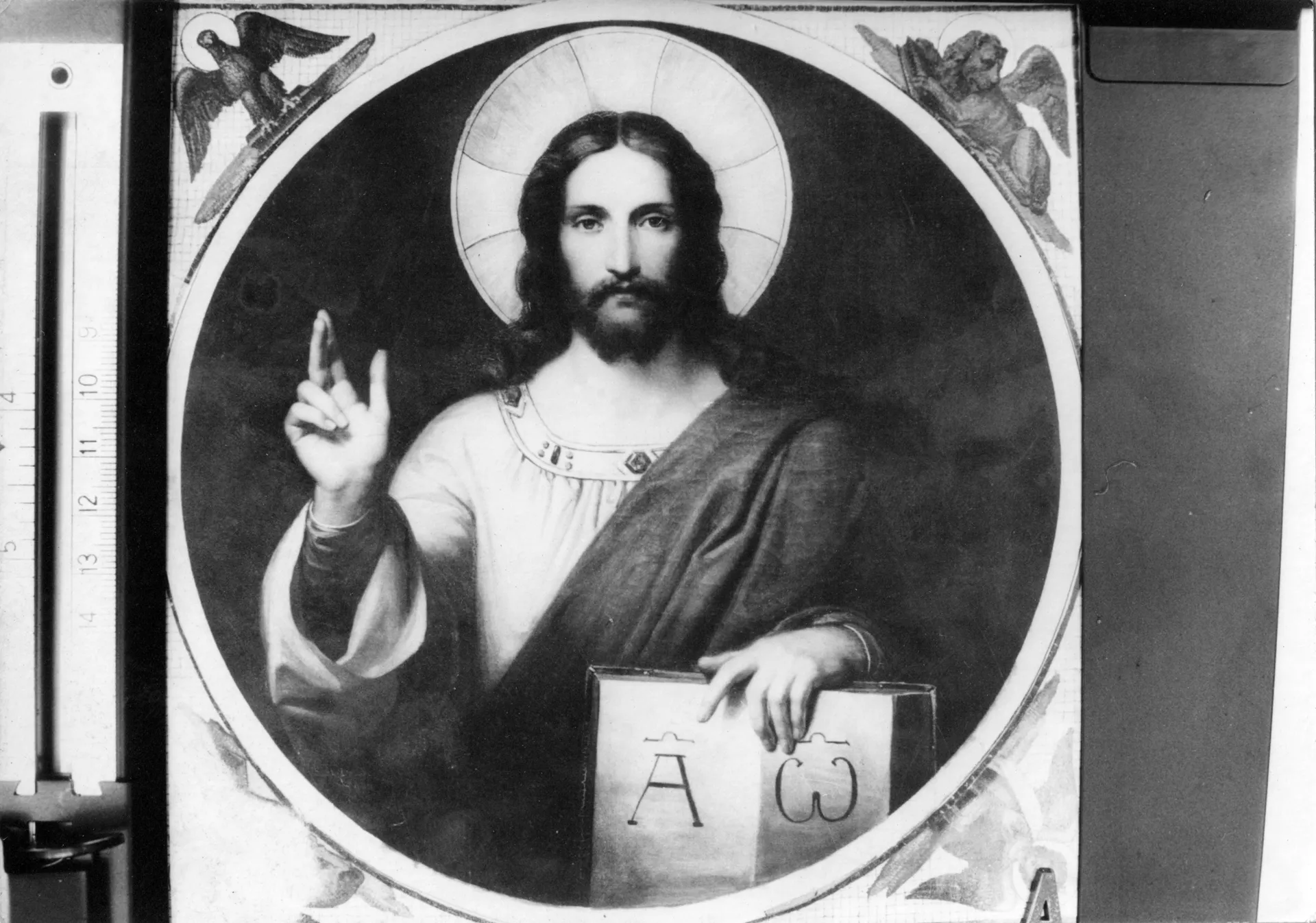
Jacques Dufrasne's Munich visit in August 1953 began a deliberate effort to recover the painter's record. The trip drew on earlier family knowledge. A Louvain relative had already consulted a dictionary of artists, found an entry under the Brüls name, and confirmed that his masterpiece was held in Munich. Dufrasne went there in person. He verified the destruction of the Munich painting and obtained a photograph of the lost work from the museum's secretary.

He continued the work through the scholarly networks of Liège. On 28 May 1954 he was admitted to the Institut Archéologique Liégeois, which gave his research a recognised scholarly setting and access to local networks. The institute formed part of the same Liège scholarly tradition that had earlier inventoried local church art.
Over roughly the same decade, from about 1955 to 1965, Marie-Louise Hucklenbroich developed a parallel and partly independent body of notes and letters. Her contribution mattered because it did not simply repeat Dufrasne. She cross-checked him, corrected him, and added oral material unavailable elsewhere.
She identified Louis as a painter of the German School, associated him with Pope Pius IX (1792–1878), repeated the story of Louis's marriage and daughter, and recorded works not present in the earlier Dufrasne catalogue, including Sérénade sur terrasse. She also preserved the only surviving oral description of the Drinhausen estate as a physical place, with its long avenue of oak trees and its sale after the family left.
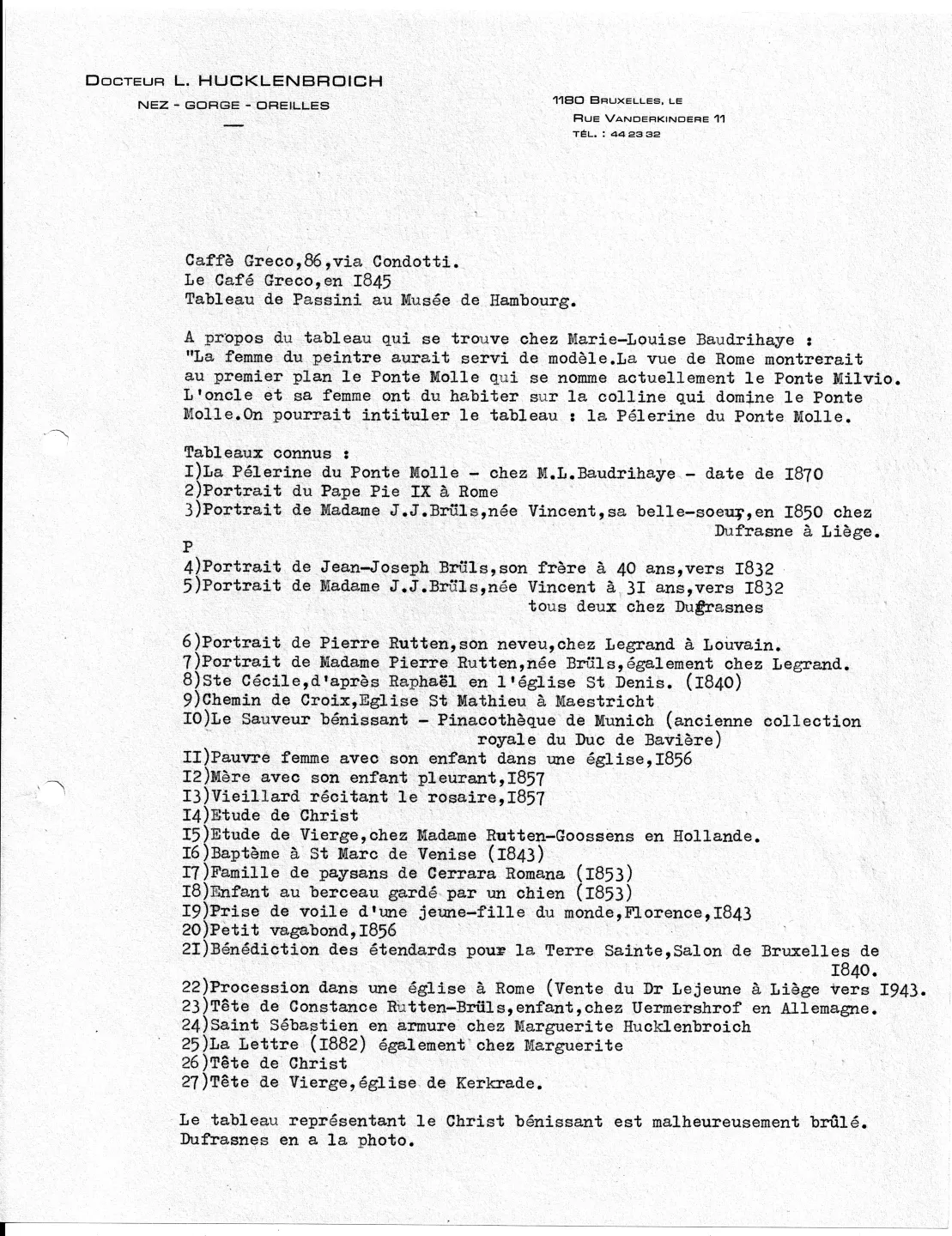
The dossier compiled on Dr Léon Hucklenbroich's headed notepaper in Brussels drew mainly on Jacques Dufrasne's research, with later family additions. It became the central private archive of this revival, gathering a biographical summary, a typed works list of twenty-seven entries derived from the handwritten Dufrasne inventory, genealogical material, and photographs of the Verano tomb and the Munich painting.
The file also established several themes that would remain central to all later work on Brüls: the dispute over his birthplace, the identification of Maria Micocci, the possibility of a daughter, the portrait of Pius IX, the mention of Louis's signature in the Caffè Greco Livre d'Or, and the acknowledgement that he died in Rome with his wife surviving him.
Equally important, it mapped the survival and dispersal of works after his death. It recorded family portraits in Liège and Louvain, works in Brussels and The Hague, the Saint-Denis commissions in Liège, the Stations of the Cross in Maastricht and Kerkrade, the Munich masterpiece, and pictures in private or semi-private hands.
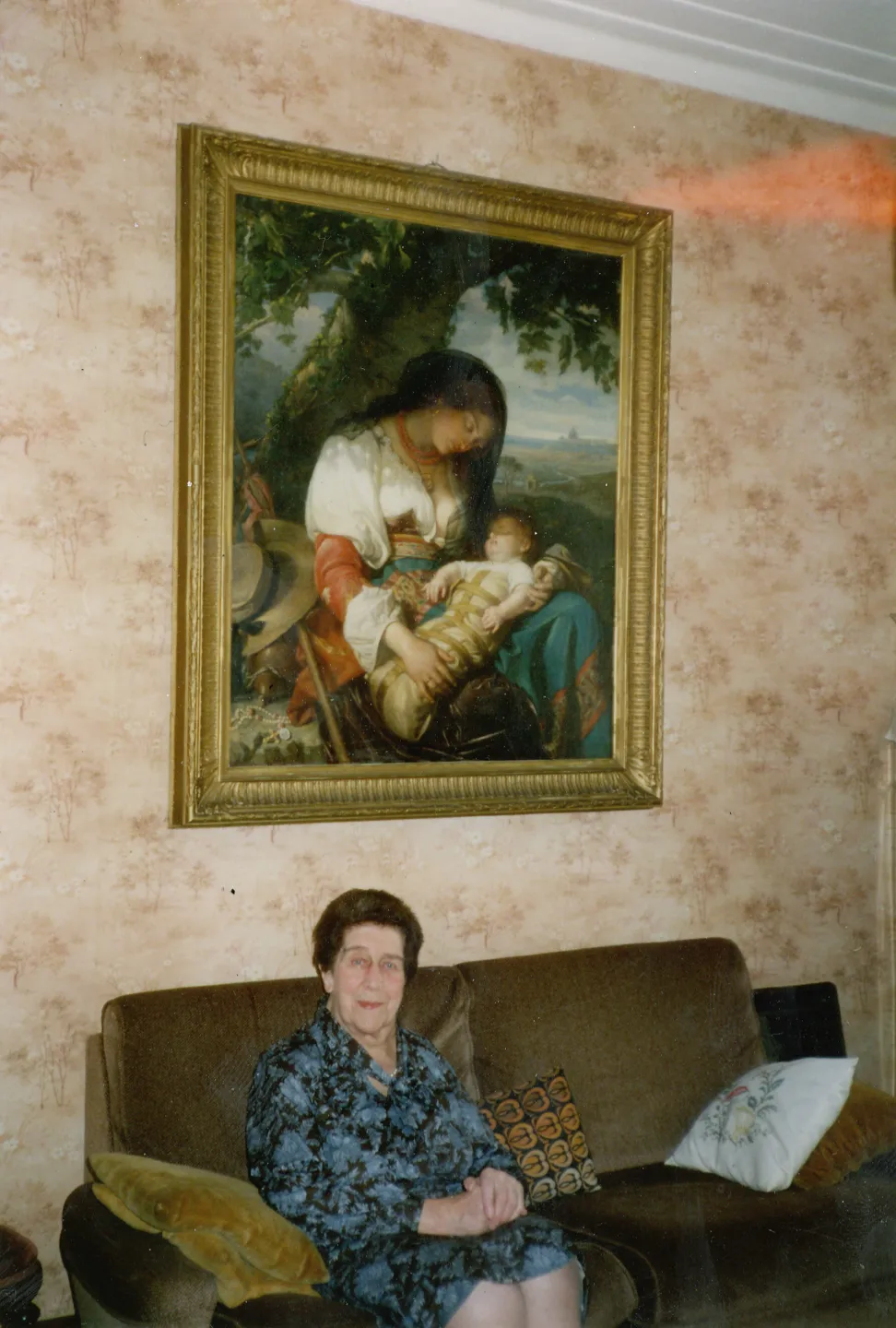
One of the listed paintings, La Pèlerine, described as la Pèlerine du Ponte Molle ou Ponte Milvio and dated 1870, was itself in Marie-Louise's own possession, held under her married name Baudrihaye-Hucklenbroich.
In 1998, Dr Léon Hucklenbroich's dossier and the Marie-Louise Hucklenbroich notes passed into my possession. Their value lay in the kind of evidence they preserved: names, locations, photographs, and partial work lists that could later be checked against archives and museum records. Before modern scholarship returned to him, descendants had already rescued much of the record.
By the early twenty-first century, his legacy existed in churches, museums, family archives, auction houses, and digital catalogues at the same time.
Modern Scholarship
In 1985, Rieke van Leeuwen's study Kopiëren in Florence, published by the Netherlands Inter-University Art History Institute in Florence, included a detailed entry on Brüls based on archival research in the Florentine galleries. Van Leeuwen published two letters written by Brüls requesting permission to copy in the Palazzo Pitti (1839) and the Uffizi (1844), and explicitly argued that Ludwig Brüls and Louis Joseph Bruls were the same person. It was the earliest published resolution of the identity split that had persisted since the 1911 Thieme-Becker entries. The identification rested on the 1844 Uffizi letter, in which he signed as "Brüls" while describing himself as "artiste Belge."
In 2002, Jürgen Klosa published "Auf den Spuren der alten Übacher Familie Brüls" in the Heimatkalender, drawing on documents and family portraits preserved by Marita Meyerhoff of Bonn-Buschdorf, whose late husband Bernd Meyerhoff (1932–1993) had devoted himself to researching the Brüls line. Klosa's article traced nine generations from Johann Brüls (married 1670) through to Bernd Meyerhoff himself, documented the twelve children of Peter-Joseph Brüls born at Drinhausen, and reproduced painted portraits of the painter's mother and brothers that had survived in the Meyerhoff family.

In 2005, Christine Dupont's two-volume study Modèles italiens et traditions nationales: les artistes belges en Italie (1830–1914), published by the Institut Historique Belge de Rome, offered the most comprehensive modern survey of Belgian artists in Italy. Dupont devoted a subsection to Brüls alongside Pierre Monami (1814–1857), identifying both as artists who settled permanently in Rome and were essentially absorbed into the Italian world. She confirmed his arrival in 1837, his provisorship of Saint-Julien-des-Belges, and the reported portrait of Pius IX from life.
Dupont's assessment was direct. Brüls's name did not appear among the artists Belgian visitors sought out in Rome, little was known of his production, and his role beyond the Saint-Julien provisorship remained, in her words, "very poorly defined."
A modern scholarly turn began in earnest in 2008 with Frank Pohle's publication on Louis Joseph Brüls and his work for the Lambertus parish in Kerkrade. Pohle was the first to develop a full biographical study and to undo the bibliographical split in a comprehensive way, though the identity question itself had already been resolved by Van Leeuwen in 1985. The split had been deep enough that Thieme-Becker, the most authoritative artist dictionary of the era, had carried two separate entries for "Ludwig Brüls" and "Louis Joseph Bruls" written by different contributors, with no cross-reference between them.
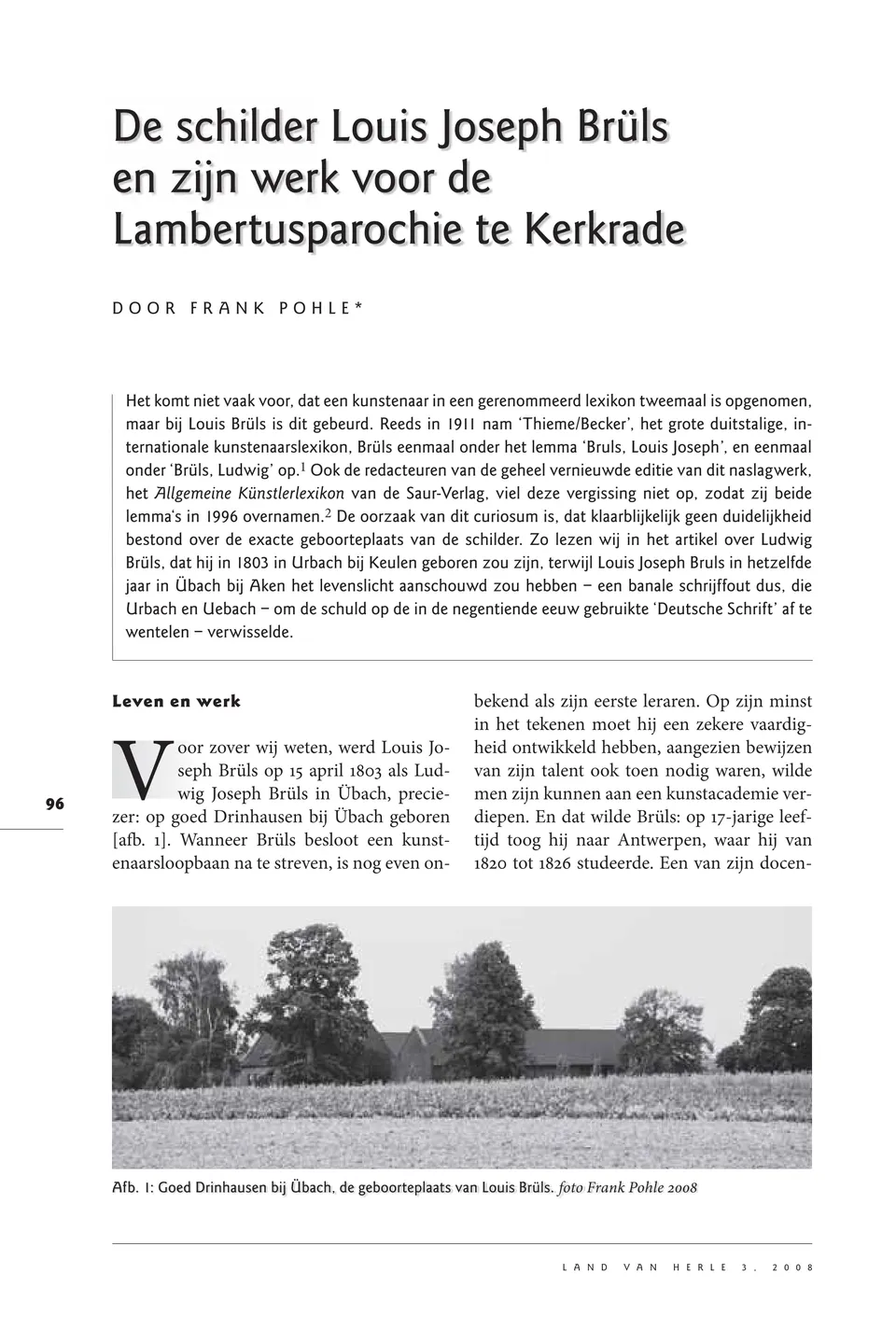
Pohle's 2010 publication confirmed the birthplace as Übach near Aachen, correcting the persistent "Urbach bei Köln" error that had circulated since the 1889 Neue Pinakothek catalogue and Noack's 1911 Thieme-Becker entry, though one contributor to that same dictionary had already given the correct location.
In 2012, Susanna Sarti's study The Campana Collection at the Royal Museum of Art and History (Brussels), published by Éditions de Boccard, gave the fullest modern scholarly account of the Belgian acquisition of Campana vases. Sarti drew on the original dossier, which begins with a letter of 3 December 1862 written by Brüls from Rome to Jean Portaels (1818–1895), describing his inspection of the remains of the Campana collection and his assessment of the vases still available. The book documents Brüls's roles as scout, intermediary, and translator of Brunn's catalogue, confirming and extending the picture first drawn by Reinach in 1905.

In 2017, Pohle carried the recovery further with a French-language study presented at the Congrès de Liège and published in the Actes of the Institut Archéologique Liégeois, the same institution Jacques Dufrasne had joined over sixty years earlier. The paper's title, "Louis Brüls (1803–1882), un peintre méconnu hors des frontières," acknowledged the transnational character of the subject and the degree to which he remained unknown.
Classification remained one of the persistent problems of his afterlife. Family material described him as a painter of the German School. Belgian records treated him as a Belgian painter. Museum and scholarly traditions classified him variously as German-Roman, Belgian, Dutch by naturalisation in one phase, or simply Roman by residence. Later project material noted that auction attributions to the Düsseldorf School were retrospective stylistic classifications rather than proof of enrolment there, while other evidence connected him more closely with the Munich Nazarene orbit.
In 2022, Esaù Dozio's study in Antike Kunst on the Basel vase acquisitions placed Brüls's surviving letters and drawings in modern scholarship and gave the fullest published account of his work as an art agent. The study showed Brüls as more than a devout Roman genre painter. He was also a connoisseur and dealer in antiquities, active in acquisition networks that connected Rome to Basel, Würzburg, and Brussels. That picture fitted older evidence about his connection to Martin von Wagner (1777–1858), the Würzburg collection, and the Campana material.
The 1826 portrait of Marie-Agnès Hoeberechts appeared at Legia-Auction in 2020, though it passed unsold. A work on cardboard, Mutter mit Säugling bei der Feldarbeit, sold at Hargesheimer in 2021. A Battesimo appeared at Casa d'Aste Arcadia in 2023.
A small portrait of Louis by Antoine Wiertz (1806–1865), painted in Rome on cardboard, was purchased from Madame Blandine de Pas and entered the Royal Museums of Fine Arts of Belgium in 2023 as inventory number 12667. It is one of the most important documentary images for his biography.

By 2026, the posthumous record of Louis Brüls had become dense but still uneven. Major public survivals were known in Mechelen, Boston, Brussels, Kerkrade, Liège, and elsewhere. The Verano tomb remained a fixed point in Rome. The family archives preserved the Brussels and The Hague holdings, the Meyerhoff family portraits in Bonn-Buschdorf, including Louis's paintings of his mother and three brothers.
From 1882 to 2026, his afterlife did not follow a simple curve of fame, obscurity, and rediscovery. Scholarship, museum cataloguing, auction records, and digital databases gradually drew the strands together. Brüls had become visible again as a real historical figure, and the efforts to recover his name and legacy became part of the historical record.